

Updated terminology for EV charging infrastructure
The UK Government has modernised the terminology relating to electric vehicle (EV) charging infrastructure to improve clarity for drivers. This article provides an overview of these changes, which will now also be implemented on our website. The official announcement was published by Zapmap.
The official names for EV charging speeds have been changed to the following:
- Standard – previously referred to as ‘slow’ charging, these chargers provide between 3kW and 7.9kW
- Standard plus – previously named ‘fast’, their power capacity ranges from 8kW to 49kW
- Rapid – this name remains the same and refers to chargers between 50kW and 149kW
- Ultra-rapid – used for chargers with power ratings of 150kW and above.
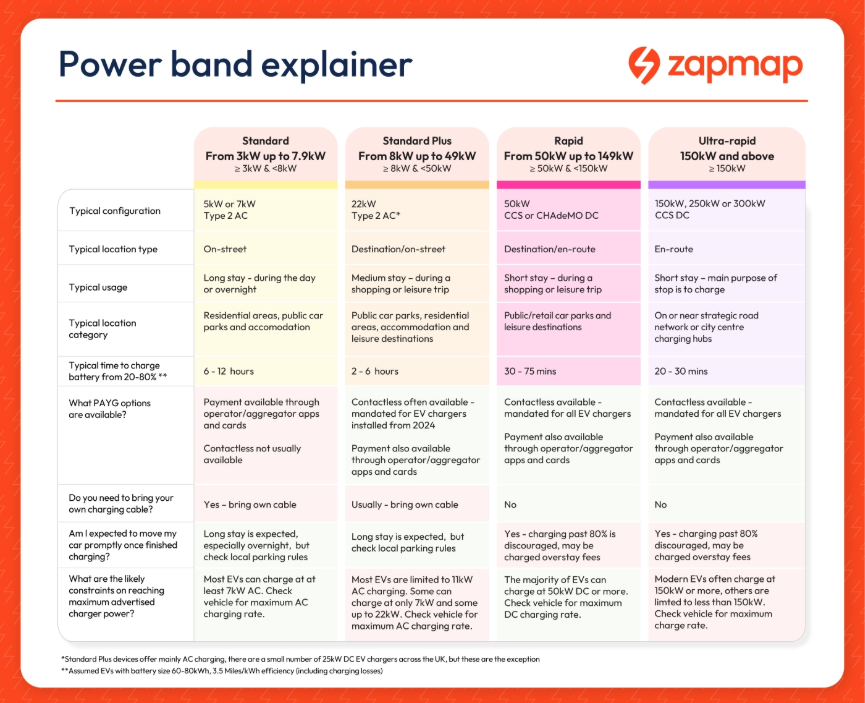
Source: Zapmap.
Changes have also been made to the terminology used for different elements of charging infrastructure. These terms are defined below.
- Connector – a socket or plug that allows to connect EV chargers to vehicles through a cable (e.g. Type 2 on AC devices; CCS, CHAdeMO and Type 2 on some DC devices)
- EV charger – a part of a charging device, which controls the charging session, enabling one EV to charge at a time (e.g. side A and B chargers on dual-socket AC devices; CCS or CHAdeMO and Type 2 chargers on some DC devices)
- Device - a physical unit which contains charging equipment, such as individual EV chargers and connectors.
Commonly used terms, such as ‘charge point’, have been found to mean different things – a charging device, charger, or even a connector, therefore, use of this term is discouraged.
It has also been stated that counting chargers will be prioritised over counting devices in order to reflect the number of EVs that can be charged simultaneously.
The diagram below shows how these updated terms relate to one another.
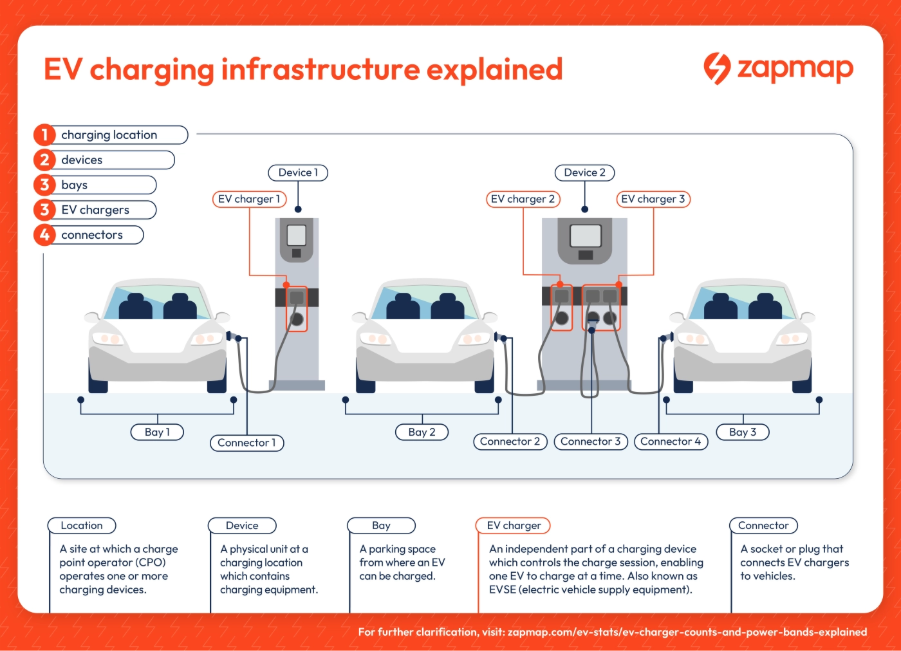
Source: Zapmap.